
A master’s degree is projected to significantly enhance career prospects and increase earning potential by 25% within five years, according to the 2026 career outlook, offering a strategic advantage in a competitive job market.
As we look towards the 2026 career outlook: how a master’s degree can increase earnings by 25% in 5 years, it becomes increasingly clear that advanced education is not just an academic pursuit but a strategic investment. In today’s rapidly evolving job market, professionals are constantly seeking ways to gain a competitive edge and secure their financial future.
The evolving landscape of the 2026 job market
The job market in 2026 is characterized by rapid technological advancements, globalization, and an increasing demand for specialized skills. Industries are undergoing transformations, creating new roles while redefining existing ones. This dynamic environment places a premium on continuous learning and adaptability.
Navigating this landscape requires more than just foundational knowledge; it demands a deeper understanding of complex systems, critical thinking, and innovative problem-solving abilities. Employers are increasingly looking for candidates who can not only perform tasks but also contribute strategically to an organization’s growth and resilience.
Key industry trends driving demand for advanced degrees
- Digital Transformation: The pervasive integration of digital technologies across all sectors necessitates professionals with expertise in data analytics, cybersecurity, artificial intelligence, and cloud computing.
- Sustainability and Green Economy: A growing focus on environmental concerns and sustainable practices is creating demand for specialists in renewable energy, environmental policy, and sustainable business management.
- Healthcare Innovation: Advances in medical technology, personalized medicine, and public health challenges are driving the need for highly skilled professionals in healthcare administration, biomedical engineering, and health informatics.
These trends highlight a shift towards roles that require a more sophisticated skill set, often best acquired through graduate-level education. A master’s degree can provide the specialized knowledge and analytical tools necessary to thrive in these burgeoning fields.
Understanding these shifts is crucial for anyone considering further education. A master’s degree positions individuals to capitalize on these emerging opportunities, making them invaluable assets in the modern workforce.
Quantifying the earning advantage of a master’s degree
The financial benefits of a master’s degree are well-documented, and projections for 2026 continue to reinforce this trend. While the exact figures can vary by field and location, a consistent pattern emerges: individuals with master’s degrees typically earn more than those with only a bachelor’s degree.
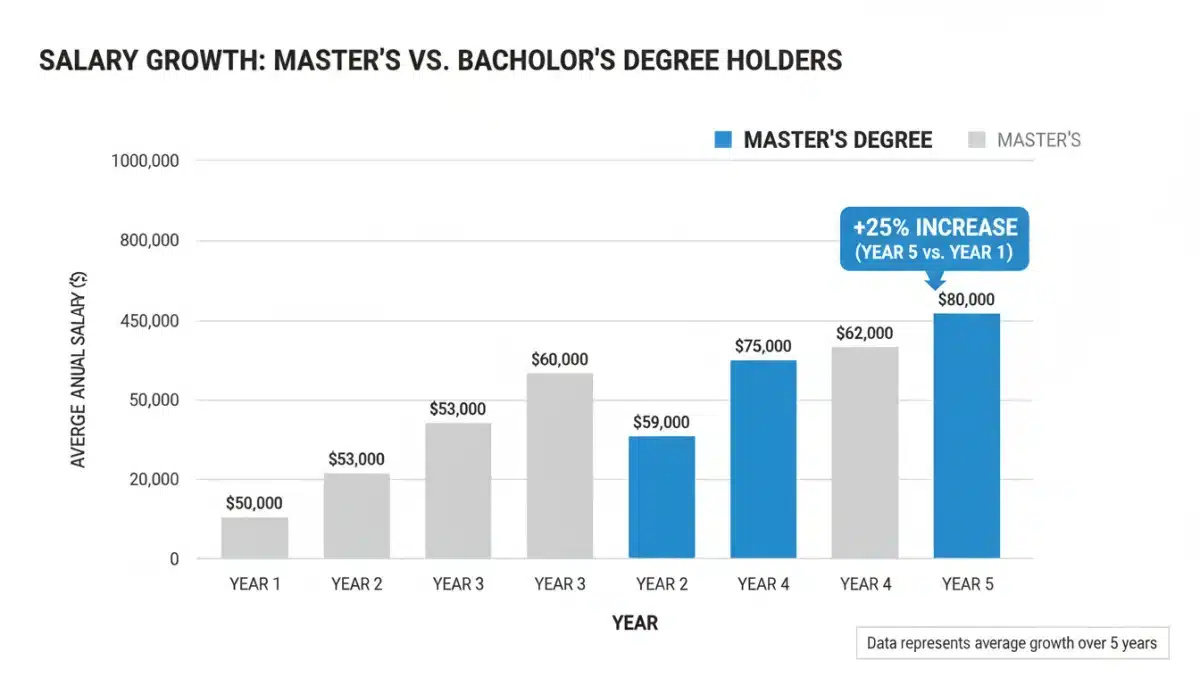
Recent studies and labor market analyses indicate that a master’s degree can lead to an average earnings increase of approximately 25% over a five-year period compared to a bachelor’s degree alone. This significant bump in salary reflects the added value and expertise that advanced education brings to the workplace.
Statistical evidence and projections for 2026
According to the Bureau of Labor Statistics (BLS), professionals with a master’s degree earned a median weekly salary of $1,574 in 2022, compared to $1,334 for those with a bachelor’s degree. This represents a substantial difference, which is projected to grow further by 2026 as demand for specialized roles intensifies.
Furthermore, unemployment rates are consistently lower for individuals with master’s degrees, indicating greater job security and career stability. This dual advantage of higher earnings and increased job security makes a compelling case for pursuing graduate studies.
- Increased earning potential: A master’s degree often unlocks higher-paying positions and faster salary progression.
- Enhanced job security: Advanced degrees can provide a buffer against economic downturns and industry shifts.
- Greater career mobility: Graduates are often better positioned for promotions and leadership roles.
The economic impact of a master’s degree extends beyond immediate salary gains; it often includes better benefits packages, opportunities for bonuses, and long-term financial stability. These factors contribute to a higher overall lifetime earning potential.
The data strongly supports the notion that investing in a master’s degree is a financially sound decision, offering a clear return on investment in the form of increased earnings and career opportunities.
Strategic fields where a master’s degree excels
While a master’s degree generally boosts earnings across various sectors, certain fields exhibit a particularly strong correlation between advanced education and significant financial returns. These strategic areas are often at the forefront of innovation and demand highly specialized knowledge.
Identifying these fields can help prospective students make informed decisions about their academic and career paths. Focusing on high-growth sectors with a clear need for advanced skills maximizes the potential for a substantial earnings increase.

Top master’s degree programs for earnings growth
- Computer Science and Information Technology: With the ongoing digital revolution, master’s degrees in areas like artificial intelligence, machine learning, and data science are in high demand, leading to lucrative positions.
- Business Administration (MBA): An MBA remains a powerful credential, especially for leadership and management roles. Specialized MBAs in finance, marketing, or operations can further enhance earning potential.
- Engineering: Advanced engineering degrees, particularly in specialized fields such as aerospace, biomedical, or software engineering, open doors to higher-level research and development positions.
- Healthcare Administration: As healthcare systems become more complex, master’s degrees in health administration, public health, and nursing leadership are critical for managing operations and improving patient care, commanding higher salaries.
These fields not only offer competitive starting salaries but also provide clear pathways for rapid career progression and continuous professional development. The specialized knowledge gained through these programs directly translates into higher value for employers.
Choosing a master’s program in one of these strategic fields can significantly accelerate career growth and ensure a substantial return on educational investment.
Beyond salary: intangible benefits of advanced education
While increased earnings are a primary motivator for pursuing a master’s degree, the benefits extend far beyond financial gains. Advanced education cultivates a range of intangible advantages that contribute to overall career satisfaction and personal growth.
These non-monetary benefits often enhance an individual’s professional trajectory in ways that are difficult to quantify but are nonetheless invaluable. They contribute to a more fulfilling and impactful career.
Professional development and personal growth
- Enhanced Critical Thinking: Graduate programs rigorously train students to analyze complex problems, synthesize information, and develop innovative solutions.
- Expanded Professional Network: Studying at the graduate level connects individuals with peers, faculty, and industry leaders, opening doors to mentorship, collaboration, and future opportunities.
- Increased Job Satisfaction: Often, a master’s degree allows individuals to pursue roles that align more closely with their passions and intellectual interests, leading to greater fulfillment.
- Leadership Skills: Many master’s programs are designed to develop strong leadership, communication, and team-building skills, preparing graduates for management positions.
The intellectual challenge and specialized learning environment of a master’s program foster a deep sense of accomplishment and expertise. Graduates often report feeling more confident and capable in their professional roles.
These intangible benefits, while not directly reflected in a paycheck, contribute significantly to a richer and more rewarding professional life, making the investment in a master’s degree a holistic one.
Navigating the cost and financing of a master’s degree
The decision to pursue a master’s degree often involves significant financial considerations. Tuition fees, living expenses, and foregone income can represent a substantial investment. However, various strategies and resources are available to help manage these costs.
Understanding the financial landscape of graduate education is crucial for making an informed decision. With careful planning, the cost of a master’s degree can be made manageable, ensuring that the long-term benefits outweigh the initial investment.
Funding options and financial planning strategies
- Scholarships and Grants: Numerous scholarships and grants are specifically designed for graduate students, often based on academic merit, financial need, or specific fields of study.
- Assistantships and Fellowships: Many universities offer teaching or research assistantships that provide tuition waivers and stipends in exchange for work within the department.
- Federal Student Loans: Government-backed loans often offer more favorable terms and repayment options compared to private loans.
- Employer Sponsorship: Some companies offer tuition reimbursement or sponsorship programs for employees pursuing advanced degrees relevant to their roles.
Prospective students should thoroughly research all available funding options and create a detailed financial plan. This plan should account for all expenses, including tuition, books, living costs, and any potential loss of income during study.
While the upfront cost can be daunting, viewing a master’s degree as an investment in human capital helps frame the financial decision. The projected increase in earnings and career opportunities often provides a strong return on this investment over time.
Future-proofing your career with a master’s degree
In an era of rapid technological change and economic uncertainty, future-proofing one’s career has become a critical objective for many professionals. A master’s degree serves as a powerful tool in this endeavor, equipping individuals with adaptable skills and specialized knowledge that remain relevant even as industries evolve.
The ability to anticipate and respond to change is a hallmark of successful professionals in 2026 and beyond. Advanced education fosters this adaptability, making graduates resilient in the face of disruption.
Adaptability and specialized skills for long-term success
A master’s degree program often emphasizes advanced research methodologies, complex problem-solving, and interdisciplinary approaches. These skills are highly transferable and valuable across various sectors, preparing graduates for diverse career paths.
Furthermore, the focus on critical analysis and innovation within graduate studies enables individuals to not just keep pace with change but to drive it. They become thought leaders and innovators, rather than merely followers of trends.
- Continuous Learning Mindset: Graduate education instills a commitment to lifelong learning, essential for staying current in any field.
- Problem-Solving Expertise: Master’s programs train individuals to tackle complex, unstructured problems, a skill highly valued by employers.
- Strategic Vision: Advanced degrees often provide a broader perspective on industry trends and global challenges, enabling graduates to make informed strategic decisions.
- Innovation and Creativity: The research-intensive nature of many master’s programs fosters an environment for developing new ideas and approaches.
By investing in a master’s degree, individuals are not just acquiring a credential; they are developing a robust skill set that enhances their long-term career viability and ensures they remain competitive in a dynamic job market.
This strategic advantage allows graduates to not only secure higher earnings but also to enjoy a more stable, meaningful, and future-ready career.
The decision to pursue advanced education
The choice to pursue a master’s degree is a significant one, impacting both personal and professional trajectories. It involves careful consideration of career goals, financial implications, and the commitment required for rigorous academic study. However, the potential rewards, particularly in the context of the 2026 career outlook, are substantial.
Making this decision requires a thorough understanding of the benefits and challenges, ensuring that the path chosen aligns with individual aspirations and market realities.
Weighing the pros and cons for your unique path
While the data strongly supports the financial and professional advantages of a master’s degree, it is important for each individual to assess their unique circumstances. Factors such as current career stage, industry, personal financial situation, and long-term goals should all play a role in the decision-making process.
Engaging in informational interviews with professionals in desired fields, speaking with career counselors, and attending graduate school fairs can provide valuable insights to help clarify this complex decision.
- Pros: Higher earning potential, increased job security, enhanced career mobility, expanded professional network, personal and intellectual growth.
- Cons: Significant financial investment, time commitment, potential for temporary income loss, rigorous academic demands.
Ultimately, the decision to pursue a master’s degree should be a well-informed one, based on a comprehensive understanding of its potential impact. For many, the strategic advantages and long-term benefits, especially the projected 25% increase in earnings over five years, make it a worthwhile endeavor.
By carefully evaluating all aspects, individuals can confidently embark on a path that promises to significantly enhance their career outlook and overall life satisfaction.
| Key Aspect | Description |
|---|---|
| Earnings Increase | Master’s degree holders can expect approximately a 25% increase in earnings within 5 years. |
| Job Market 2026 | High demand for specialized skills due to tech, green economy, and healthcare innovation. |
| Strategic Fields | Computer Science, MBA, Engineering, and Healthcare Administration offer significant returns. |
| Intangible Benefits | Enhanced critical thinking, expanded networks, increased job satisfaction, and leadership skills. |
Frequently asked questions about master’s degrees and earnings
Projections indicate that individuals with a master’s degree can expect an average earnings increase of approximately 25% within five years compared to those with only a bachelor’s degree. This figure can vary based on your specific field and location.
Fields such as computer science, business administration (MBA), various engineering specializations, and healthcare administration consistently show high earning potential and strong career growth for master’s degree holders.
For many, yes. Beyond the significant increase in earnings, a master’s degree offers enhanced job security, greater career mobility, expanded professional networks, and valuable personal and intellectual growth that contribute to long-term success.
Several options exist, including scholarships, grants, teaching or research assistantships, federal student loans, and employer tuition reimbursement programs. Thorough research and financial planning are key to managing costs effectively.
A master’s degree equips you with specialized knowledge, critical thinking, and adaptability—skills highly valued in evolving job markets. It fosters a continuous learning mindset and provides a strategic vision to navigate technological advancements and industry changes.
Conclusion
The 2026 career outlook strongly underscores the strategic advantage of a master’s degree in significantly boosting earning potential and career trajectory. With projections indicating an approximate 25% increase in earnings within five years, advanced education stands out as a powerful investment in one’s professional future. Beyond the compelling financial returns, a master’s degree cultivates essential skills, expands professional networks, and enhances job satisfaction, equipping individuals to thrive in a dynamic global economy. While the decision requires careful planning, the long-term benefits in terms of financial security, career resilience, and personal growth make pursuing a master’s degree a profoundly rewarding endeavor for aspiring professionals.