
The Pentagon’s 2026 Defense Strategy report outlines a comprehensive plan to bolster national security through significant investments in cybersecurity and the development of advanced weaponry, addressing contemporary and future global challenges effectively.
The recent announcement of the Pentagon Releases 2026 Defense Strategy Report: Focus on Cybersecurity and Advanced Weaponry – RECENT UPDATES marks a pivotal moment in understanding the future trajectory of U.S. national security. This comprehensive document provides an insightful look into how the United States plans to adapt its military capabilities and strategic approaches to confront an increasingly complex global threat landscape.
Understanding the Evolving Global Threat Landscape
The 2026 Defense Strategy report emerges against a backdrop of rapidly shifting geopolitical dynamics and technological advancements. Traditional state-on-state rivalries are intensifying, while non-state actors continue to pose significant, evolving threats. This complex environment necessitates a proactive and adaptable defense posture.
The report underscores the urgency of addressing multifaceted challenges, from aggressive nation-states leveraging hybrid warfare tactics to the pervasive threat of cyberattacks targeting critical infrastructure. It acknowledges that future conflicts may not be confined to traditional battlefields but could extend into the digital realm, space, and even information ecosystems.
Geopolitical Shifts and Strategic Competition
Global power dynamics are in flux, with several nations actively investing in military modernization and expanding their influence. The strategy highlights the need for the U.S. to maintain its competitive edge and deter potential adversaries effectively. This involves not only technological superiority but also robust alliances and diplomatic engagement.
- Rise of peer and near-peer competitors.
- Increased military spending by rival powers.
- Expansion of global influence through economic and military means.
In conclusion, the evolving global threat landscape demands a comprehensive and forward-looking defense strategy. The 2026 report emphasizes that understanding and anticipating these changes are paramount to safeguarding national security and promoting global stability.
Cybersecurity as the New Frontline of Defense
One of the most striking aspects of the 2026 Defense Strategy is its unequivocal recognition of cybersecurity as a primary domain of conflict. The report dedicates substantial attention to bolstering the nation’s cyber defenses and capabilities, acknowledging that adversaries are increasingly targeting digital infrastructure, military networks, and sensitive data.
Cyber warfare is no longer a theoretical concept; it is a daily reality. From espionage to disruptive attacks on essential services, the digital realm presents a persistent and insidious threat. The Pentagon’s strategy seeks to establish a resilient cyber ecosystem capable of both defending against sophisticated attacks and projecting power when necessary.
Key Pillars of Cybersecurity Enhancement
The strategy outlines several critical areas for cybersecurity investment and development. These pillars aim to create a multi-layered defense that can withstand and respond to the most advanced cyber threats. Emphasis is placed on both offensive and defensive capabilities, ensuring the U.S. can operate effectively in a contested cyber environment.
- Advanced threat detection and prevention systems.
- Enhancement of cyber intelligence gathering.
- Development of rapid response and recovery protocols.
- Investment in human capital for cybersecurity expertise.
The report also stresses the importance of collaboration with allies and private sector partners to share threat intelligence and develop collective defense mechanisms. This collaborative approach is vital, given the transnational nature of cyber threats.
Ultimately, the focus on cybersecurity within the 2026 Defense Strategy reflects a clear understanding that digital security is inextricably linked to national security. Protecting critical networks and data is not merely a technical challenge but a strategic imperative.
Revolutionizing Warfare with Advanced Weaponry
Beyond cybersecurity, the 2026 Defense Strategy places a significant emphasis on the development and deployment of advanced weaponry. This includes a wide array of technologies designed to provide a decisive military advantage and deter potential aggressors. The goal is to ensure the U.S. military remains at the forefront of technological innovation.
The report highlights the need to move beyond incremental improvements and embrace disruptive technologies. This involves investing in research and development, fostering innovation, and rapidly integrating new capabilities into the force structure. The competitive landscape demands that the U.S. outpace its adversaries in military technology.
Next-Generation Weapon Systems
Several key areas of advanced weaponry are prioritized in the strategy. These systems are expected to redefine future warfare, offering enhanced precision, speed, and operational flexibility. The focus is on capabilities that can operate effectively across all domains: land, sea, air, space, and cyber.
- Hypersonic missile technology.
- Artificial intelligence (AI) and machine learning in autonomous systems.
- Directed energy weapons.
- Advanced stealth and counter-stealth technologies.
The integration of AI, in particular, is seen as transformative, enabling faster decision-making, enhanced target recognition, and more efficient resource allocation. These technologies are not merely about firepower but about creating a smarter, more agile fighting force.
In essence, the strategy’s push for advanced weaponry is about maintaining a qualitative military edge. It’s about ensuring that the U.S. military possesses the tools necessary to protect its interests and respond effectively to any threat, anywhere in the world.
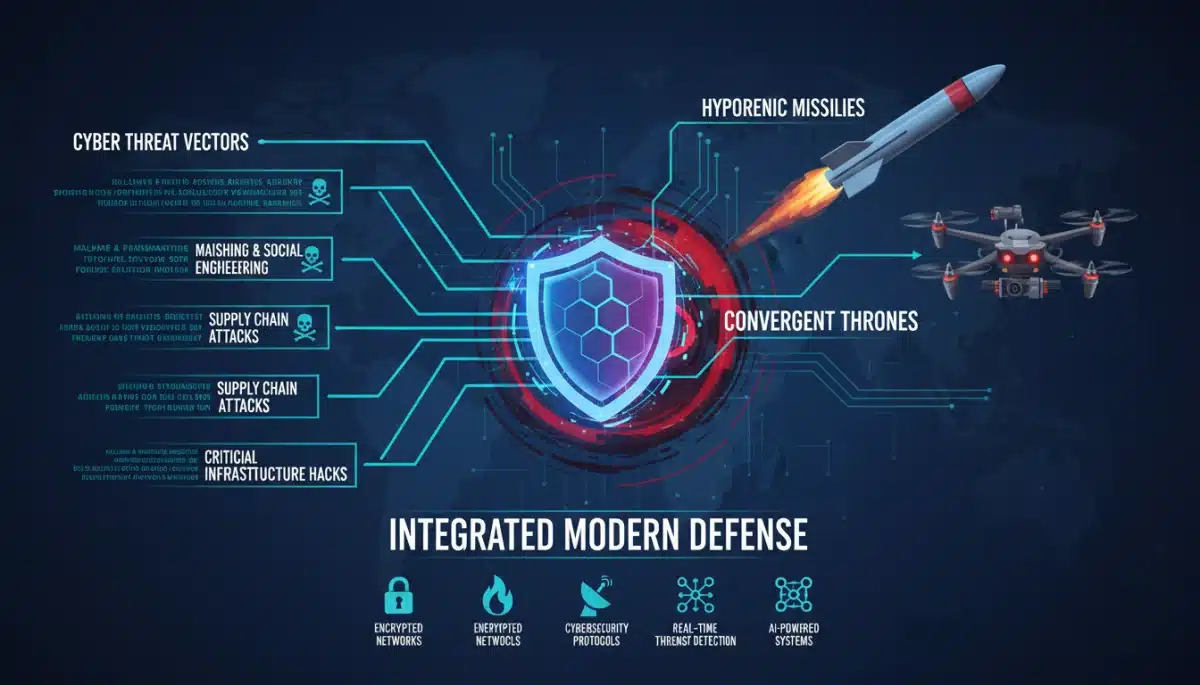
Integrating AI and Machine Learning into Defense Operations
Artificial Intelligence (AI) and Machine Learning (ML) are not just buzzwords in the 2026 Defense Strategy; they are foundational elements of future military operations. The report outlines a comprehensive plan to integrate these technologies across various aspects of defense, from intelligence analysis to logistics and autonomous systems.
The potential of AI to revolutionize military capabilities is immense. It can process vast amounts of data at speeds impossible for humans, identify patterns, and provide critical insights that enhance decision-making. This strategic advantage is deemed crucial in a fast-paced, information-rich battlespace.
AI’s Role in Modern Warfare
The strategy details how AI and ML will be leveraged to improve efficiency, accuracy, and operational effectiveness. This includes applications in predictive maintenance, intelligent reconnaissance, and advanced command and control systems. The goal is to create a more responsive and intelligent defense apparatus.
- Enhanced intelligence, surveillance, and reconnaissance (ISR).
- Predictive logistics and supply chain optimization.
- Autonomous and semi-autonomous operational platforms.
- Cyber defense and offense automation.
Ethical considerations surrounding AI in warfare are also addressed, with the report emphasizing the development of responsible AI guidelines and frameworks. The Pentagon seeks to ensure that AI technologies are deployed in a manner consistent with humanitarian principles and international law.
The integration of AI and ML is therefore a dual-pronged effort: maximizing operational advantage while adhering to ethical standards. This balance is critical for maintaining public trust and ensuring the responsible deployment of these powerful technologies.
Strengthening Alliances and Partnerships for Collective Security
A recurring theme throughout the 2026 Defense Strategy is the indispensable role of alliances and partnerships. The report reiterates that collective security is paramount in addressing global challenges and that no single nation can effectively tackle the full spectrum of threats alone. Strengthening these relationships is a strategic imperative.
The strategy emphasizes building interoperability with allied forces, sharing intelligence, and conducting joint exercises. These collaborative efforts enhance mutual defense capabilities, deter aggression, and promote regional stability. The U.S. aims to be a reliable and capable partner on the global stage.
Key Aspects of Alliance Reinforcement
The report details specific initiatives aimed at deepening defense cooperation. These include technology sharing agreements, joint research and development programs, and coordinated responses to emerging threats. The focus is on creating a robust network of partners capable of collective action.
- Joint military exercises and training.
- Information and intelligence sharing agreements.
- Collaborative development of defense technologies.
- Support for partners’ defense modernization efforts.
Furthermore, the strategy recognizes the importance of non-traditional partnerships, including those with international organizations and the private sector. These broader collaborations can bring diverse expertise and resources to bear on complex security challenges, particularly in areas like cybersecurity.
In conclusion, strengthening alliances and partnerships is a cornerstone of the 2026 Defense Strategy. It acknowledges that shared burdens and collective strengths are the most effective means of ensuring peace and stability in an interconnected world.
The Economic and Industrial Base Implications
Implementing the ambitious goals of the 2026 Defense Strategy will require significant investment and a robust industrial base. The report delves into the economic implications, highlighting the need for sustained funding, efficient resource allocation, and a healthy defense industrial sector capable of meeting future demands.
The strategy recognizes that technological superiority and military readiness are directly tied to the strength of the nation’s industrial base. This includes not only prime contractors but also the vast network of small and medium-sized enterprises that contribute to the defense ecosystem.
Investing in Innovation and Production
To support the strategy, the Pentagon plans to prioritize investments in critical technologies and manufacturing capabilities. This involves fostering a competitive environment, streamlining procurement processes, and ensuring access to essential raw materials and skilled labor. The goal is to avoid bottlenecks and accelerate the delivery of advanced systems.
- Increased funding for defense research and development.
- Modernization of defense manufacturing infrastructure.
- Development of a skilled workforce for defense industries.
- Diversification of supply chains to enhance resilience.
The report also emphasizes the importance of public-private partnerships to leverage commercial innovation and accelerate the transition of cutting-edge technologies from the laboratory to the battlefield. This collaborative approach is seen as vital for maintaining a technological edge.
Ultimately, the economic and industrial base implications underscore the comprehensive nature of the 2026 Defense Strategy. It’s not just a military plan but a national endeavor requiring broad-based support and strategic investment to succeed.
Addressing Future Challenges and Maintaining Deterrence
The 2026 Defense Strategy is explicitly designed to address future challenges and ensure the continued effectiveness of U.S. deterrence. It looks beyond immediate threats to anticipate long-term strategic shifts and technological disruptions. The aim is to create a defense posture that is resilient, adaptable, and forward-looking.
Maintaining deterrence in a rapidly changing world requires more than just military might; it demands credibility, agility, and a clear understanding of potential adversaries’ capabilities and intentions. The strategy seeks to project strength and resolve, discouraging aggression before it begins.
Strategic Foresight and Adaptability
The report emphasizes the need for continuous assessment of the global security environment and a willingness to adapt the strategy as new threats emerge. This involves investing in intelligence capabilities, fostering strategic analysis, and promoting a culture of innovation within the defense establishment.
- Continuous monitoring of global security trends.
- Flexibility in resource allocation and strategic priorities.
- Investment in advanced intelligence gathering and analysis.
- Promoting strategic thinking and scenario planning.
Moreover, the strategy highlights the importance of maintaining a balanced force structure capable of responding to a wide range of contingencies, from high-intensity conflict to humanitarian assistance. This versatility ensures that the U.S. can effectively safeguard its interests and contribute to global security.
In conclusion, the 2026 Defense Strategy is a blueprint for navigating a complex future. By focusing on adaptability, innovation, and strong partnerships, it aims to ensure the U.S. remains a formidable force for peace and security in the decades to come.
| Key Focus Area | Brief Description |
|---|---|
| Cybersecurity Priority | Elevated to a primary domain of conflict, demanding robust defense and offensive capabilities against state and non-state actors. |
| Advanced Weaponry | Significant investment in hypersonic missiles, AI-powered autonomous systems, and directed energy weapons for strategic advantage. |
| AI Integration | Extensive integration of Artificial Intelligence and Machine Learning across intelligence, logistics, and operational platforms for enhanced decision-making. |
| Alliance Reinforcement | Emphasis on strengthening alliances, fostering interoperability, and sharing intelligence for collective security and deterrence. |
Frequently Asked Questions About the 2026 Defense Strategy
The primary objective is to adapt U.S. military capabilities to counter evolving global threats, focusing on maintaining a competitive edge through advanced technology and robust alliances. It aims to secure national interests and deter aggression effectively.
Cybersecurity is designated as a critical domain of conflict. The strategy prioritizes investments in advanced threat detection, intelligence gathering, rapid response protocols, and skilled personnel to defend against and respond to cyberattacks.
The strategy prioritizes hypersonic missiles, AI-powered autonomous systems, directed energy weapons, and advanced stealth technologies. These are intended to provide a decisive military advantage across all operational domains.
Alliances and partnerships are considered indispensable for collective security. The strategy emphasizes strengthening interoperability, intelligence sharing, and joint exercises to enhance mutual defense capabilities and global stability.
The strategy requires sustained investment, efficient resource allocation, and a strong defense industrial base. It focuses on funding R&D, modernizing manufacturing, and developing a skilled workforce to support technological advancements.
Conclusion
The 2026 Defense Strategy report from the Pentagon represents a clear and assertive vision for safeguarding U.S. national security in an increasingly volatile world. By placing a strong emphasis on cybersecurity and the rapid development and integration of advanced weaponry, the strategy aims to address both current and anticipated threats. Its holistic approach, encompassing technological superiority, robust alliances, and a resilient industrial base, underscores a commitment to maintaining a decisive military advantage and ensuring global stability. This comprehensive plan is not merely a reactive measure but a proactive blueprint designed to navigate the complexities of future conflicts and maintain peace through strength and innovation.