
The US federal government’s $50 billion investment in AI R&D by 2026 is poised to significantly accelerate innovation and reshape the nation’s financial landscape.
The announcement that the Federal Government to Invest $50 Billion in AI Research and Development by 2026: What This Means for Innovation – FINANCIAL IMPACT is a monumental declaration, signaling a new era of technological advancement and economic transformation in the United States. This substantial commitment is not merely a budget allocation; it is a strategic maneuver designed to cement America’s position at the forefront of global AI leadership. What ripple effects can we expect from such an unprecedented injection of capital into the AI ecosystem?
Understanding the Scope of the $50 Billion AI Investment
The federal government’s commitment of $50 billion towards AI research and development by 2026 marks a pivotal moment for the nation’s technological future. This substantial funding is not a singular expenditure but a multi-faceted strategy designed to infuse capital into various critical areas of AI, from fundamental research to practical applications and infrastructure development. The goal extends beyond mere scientific advancement; it aims to create a robust, resilient, and ethically sound AI ecosystem that benefits all Americans.
Key Investment Areas
This massive investment will be strategically distributed across several key domains, ensuring comprehensive growth and development within the AI landscape. It’s a holistic approach, recognizing that AI’s potential can only be fully realized through simultaneous advancements in multiple interconnected fields.
- Fundamental Research: A significant portion will bolster basic AI science, exploring new algorithms, computational models, and theoretical frameworks that form the bedrock of future innovations. This includes areas like machine learning, neural networks, and natural language processing.
- Applied Research and Development: Funds will target specific applications in critical sectors such as healthcare, defense, energy, and transportation. This aims to bridge the gap between theoretical breakthroughs and real-world solutions, fostering technologies that address societal challenges.
- Infrastructure and Workforce Development: Investment will also flow into building advanced computing infrastructure, such as supercomputers and cloud resources, essential for complex AI computations. Furthermore, programs will focus on training and educating a skilled AI workforce, from researchers to engineers and ethicists.
The scope of this investment highlights a clear federal mandate to not only innovate but also to establish the foundational elements necessary for sustained AI leadership. It acknowledges that a thriving AI sector requires both groundbreaking ideas and the practical means to bring them to fruition, supported by a skilled human capital base. This comprehensive strategy is designed to create a self-reinforcing cycle of innovation and growth.
Accelerating Innovation Across Industries
The injection of $50 billion into AI R&D is expected to act as a powerful catalyst, accelerating innovation across virtually every industry sector within the United States. This isn’t just about creating new AI-specific companies; it’s about empowering existing industries to leverage AI for enhanced efficiency, new product development, and transformative service delivery. The ripple effect will be profound, touching areas from manufacturing to healthcare, finance, and even creative arts.
One of the primary impacts will be seen in the rapid prototyping and deployment of AI solutions. With increased funding, research institutions and private companies will have greater resources to experiment, fail fast, and iterate on designs, leading to quicker advancements. This accelerated pace of innovation will translate into tangible benefits for consumers and businesses alike.
Transformative Sectoral Impacts
The diverse nature of AI applications means that its influence will be felt uniquely across various sectors, leading to specialized innovations tailored to specific industry needs.
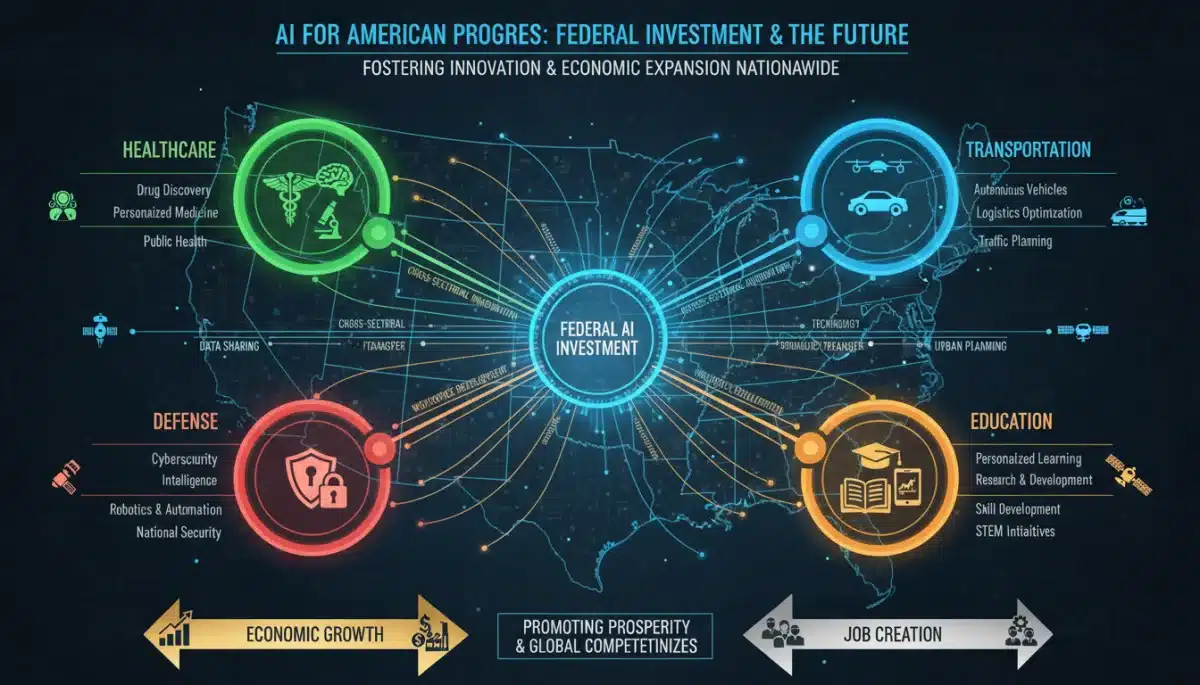
- Healthcare: Expect breakthroughs in AI-powered diagnostics, personalized medicine, drug discovery, and efficient hospital management. AI can analyze vast datasets to identify patterns invisible to the human eye, leading to earlier disease detection and more effective treatments.
- Manufacturing and Robotics: AI will drive smarter automation, predictive maintenance, and optimized supply chains. Factories will become more adaptable, efficient, and capable of producing highly customized products at scale.
- Transportation: Autonomous vehicles, intelligent traffic management systems, and optimized logistics networks will see significant advancements. This will lead to safer, more efficient, and environmentally friendly transportation solutions.
Beyond these direct applications, the investment will foster a culture of innovation, encouraging cross-disciplinary collaboration and the emergence of entirely new industries built around AI capabilities. This catalytic effect will extend far beyond the initial funding, creating a dynamic environment where continuous innovation becomes the norm. The goal is to ensure that the US remains a global leader in developing and deploying cutting-edge AI technologies, driving economic competitiveness and societal progress.
The Financial Impact: Economic Growth and Job Creation
The federal government’s $50 billion investment in AI R&D by 2026 is not merely a technological initiative; it is a powerful economic stimulus package designed to generate significant financial returns for the nation. This substantial capital injection is anticipated to fuel robust economic growth, create a multitude of new jobs, and enhance the overall productivity and competitiveness of the US economy. The financial impact will be felt across various layers, from direct investment returns to indirect benefits stemming from increased innovation and efficiency.
One of the most immediate financial impacts will be the stimulation of the research and development sector itself. Universities, national labs, and private companies engaged in AI research will see increased funding, leading to more projects, higher employment for researchers, and greater investment in infrastructure. This direct economic activity forms the bedrock upon which further growth will be built.
New Job Markets and Economic Shifts
The rise of AI will inevitably lead to shifts in the labor market, but the overall outlook points towards significant job creation in new and evolving fields. While some routine tasks may be automated, the demand for AI specialists, data scientists, engineers, ethicists, and support personnel will surge.
- High-Skill Job Creation: The investment will directly create high-paying jobs in AI research, development, deployment, and maintenance. These roles require specialized skills and will drive demand for advanced education and training programs.
- Complementary Roles: AI systems require human oversight, interpretation, and interaction. This will lead to new roles in AI ethics, human-AI collaboration, and user experience design, ensuring that AI tools are effective and responsible.
- Economic Multiplier Effect: The innovations spurred by AI will create new industries and expand existing ones, leading to indirect job creation across various sectors. For example, AI-driven advancements in healthcare will necessitate more healthcare professionals trained in utilizing these new tools.
Furthermore, the enhanced productivity brought about by AI adoption across industries will boost GDP, making American businesses more competitive on a global scale. This improved efficiency can lead to lower production costs, higher quality goods and services, and ultimately, greater economic prosperity. The financial returns on this investment are expected to far exceed the initial outlay, creating a lasting legacy of economic strength and technological leadership.
Ethical Considerations and Responsible AI Development
As the federal government commits $50 billion to AI R&D, a critical component of this investment must be the unwavering focus on ethical considerations and the development of responsible AI. The rapid advancement of artificial intelligence brings with it profound societal implications, and it is imperative that innovation is balanced with a strong framework for ethical governance, fairness, transparency, and accountability. Without such a framework, the benefits of AI could be overshadowed by unintended negative consequences, eroding public trust and exacerbating existing societal inequalities.
The investment must therefore not only fund technological breakthroughs but also support extensive research into AI ethics, bias detection and mitigation, privacy protection, and robust security measures. This dual approach ensures that as AI becomes more powerful and pervasive, it remains a tool for good, serving humanity’s best interests.
Addressing Potential Pitfalls
Developing AI responsibly requires proactively addressing potential challenges and designing systems that are inherently fair and transparent. This involves a multi-stakeholder approach, bringing together technologists, ethicists, policymakers, and civil society representatives.
- Bias Mitigation: AI systems, when trained on biased data, can perpetuate and even amplify societal prejudices. A significant part of responsible AI development involves creating methods to identify and eliminate bias in datasets and algorithms, ensuring equitable outcomes.
- Transparency and Explainability: ‘Black box’ AI models, where decisions are made without clear human understanding, pose risks in critical applications. Research into explainable AI (XAI) will be crucial to ensure that AI decisions can be understood, audited, and justified, fostering trust and accountability.
- Privacy and Data Security: AI often relies on vast amounts of data, making privacy a paramount concern. Investment must support the development of privacy-preserving AI techniques, such as federated learning and differential privacy, to protect sensitive information while still enabling AI advancements.
The federal government’s role in championing responsible AI development is critical. By embedding ethical principles into the very fabric of AI research and deployment, the US can set a global standard, demonstrating that technological progress and societal well-being are not mutually exclusive but rather interdependent goals. This ensures that the $50 billion investment yields not only innovation but also a future where AI serves humanity ethically and equitably.
Global Competitiveness and National Security Implications
The federal government’s $50 billion investment in AI R&D by 2026 carries significant implications for global competitiveness and national security. In an increasingly interconnected and technologically driven world, leadership in AI is synonymous with geopolitical influence and economic dominance. This strategic funding aims to solidify the United States’ position as a global leader in AI, ensuring its capacity to innovate, defend, and thrive in the coming decades.
The race for AI supremacy is a global one, with major powers heavily investing in their own AI capabilities. By making such a substantial commitment, the US government signals its intent to outpace rivals, foster a vibrant domestic AI industry, and attract top talent from around the world. This investment is not just about technology; it’s about securing future economic prosperity and maintaining a strategic advantage.
Strengthening National Defense
AI’s applications in national security are vast and transformative, ranging from advanced intelligence analysis to autonomous defense systems. The investment will directly enhance the nation’s defense capabilities, ensuring that the US military remains at the cutting edge of technology.
- Enhanced Intelligence and Surveillance: AI can process and analyze massive amounts of data from various sources, providing critical insights for intelligence gathering and threat detection, enhancing early warning systems.
- Cybersecurity Reinforcement: AI-powered tools can detect and respond to cyber threats with unprecedented speed and accuracy, bolstering national cybersecurity infrastructure against state-sponsored attacks and criminal enterprises.
- Autonomous Systems and Logistics: Development of AI for autonomous drones, vehicles, and logistical systems will improve operational efficiency, reduce human risk in hazardous environments, and enhance overall military readiness.
Beyond defense, leadership in AI also translates into significant economic advantages. Countries that lead in AI development will be better positioned to create high-value industries, attract foreign investment, and set global standards for technology and trade. This investment is a proactive measure to ensure that the US remains a pivotal player on the world stage, both economically and strategically, leveraging AI as a tool for both prosperity and security.
Challenges and Opportunities in Implementation
Implementing a $50 billion federal investment in AI R&D by 2026 presents both formidable challenges and unparalleled opportunities. Successfully channeling such a significant sum requires meticulous planning, effective coordination across various government agencies, academia, and the private sector, and a clear vision for desired outcomes. Navigating these complexities will be crucial to maximizing the return on this substantial public investment and realizing its full potential for innovation and financial impact.
One of the primary challenges lies in ensuring that funding is allocated efficiently and effectively, avoiding bureaucratic bottlenecks and fostering genuine groundbreaking research rather than incremental advancements. The government must establish robust mechanisms for oversight, accountability, and performance measurement to track progress and adjust strategies as needed. This requires a dynamic approach, capable of adapting to the fast-evolving landscape of AI technology.
Maximizing Impact and Overcoming Hurdles
To fully capitalize on this investment, several strategic opportunities must be seized, while common implementation hurdles need to be proactively addressed.
- Talent Pipeline Development: A critical opportunity is to significantly expand the national AI talent pipeline. This involves investing in STEM education from K-12, supporting university research programs, and fostering vocational training for AI-related skills. Attracting and retaining top AI talent is paramount.
- Public-Private Partnerships: Encouraging strong collaborations between government agencies, academic institutions, and private industry will be vital. This leverages diverse expertise and resources, accelerating the translation of research into practical applications and commercial products.
- Standardization and Regulation: Developing clear standards and thoughtful regulations for AI will be a delicate balance. The challenge is to foster innovation without stifling it, while also addressing ethical concerns and ensuring public safety and trust. This requires continuous dialogue and adaptive policymaking.
The opportunities presented by this investment are vast, including the potential to create entirely new industries, solve complex societal problems, and enhance the quality of life for millions. However, realizing these opportunities depends heavily on the government’s ability to navigate the inherent challenges, ensuring that the $50 billion is not just spent, but strategically invested to build a sustainable and leading AI ecosystem for the nation.
Looking Ahead: The Future Landscape of AI in the US
The federal government’s commitment to invest $50 billion in AI R&D by 2026 is poised to fundamentally reshape the future landscape of artificial intelligence in the United States. This substantial funding signals a long-term vision, aiming to establish a sustainable ecosystem where AI innovation flourishes, permeates all sectors of the economy, and serves as a cornerstone of national prosperity and security. The implications stretch far beyond the immediate financial injection, promising a future where AI is deeply integrated into daily life and drives continuous progress.
We can anticipate a future where AI-driven solutions are more ubiquitous, sophisticated, and seamlessly integrated into various aspects of society. From smarter cities and personalized healthcare to advanced manufacturing and resilient infrastructure, AI’s presence will be felt across the board. This investment is laying the groundwork for a future where the US is not only a consumer but a primary architect of global AI advancements.
Anticipated Developments and Long-Term Vision
The strategic investment is expected to catalyze several key developments, shaping the trajectory of AI in the US for decades to come. These anticipated shifts underscore the transformative potential of the government’s commitment.
- Pervasive AI Integration: AI will move beyond specialized applications to become an integral part of everyday tools and systems, enhancing user experience and efficiency across various platforms, from personal devices to public services.
- Advanced AI Capabilities: Expect significant leaps in areas like general AI, quantum AI, and explainable AI, leading to more intelligent, adaptable, and transparent systems capable of tackling increasingly complex problems.
- Strengthened Research Ecosystem: The funding will cement the US as a global hub for AI research, attracting top talent and fostering a collaborative environment between academia, industry, and government, ensuring a continuous pipeline of innovation.
Ultimately, the $50 billion investment is a bet on the future, a strategic move to ensure that the United States remains at the vanguard of technological progress. It’s about cultivating an environment where innovation is not just encouraged but actively nurtured, leading to a future where AI serves as a powerful engine for economic growth, societal betterment, and continued global leadership. The landscape of AI in the US by 2026 and beyond will be defined by the foresight and commitment demonstrated today.
| Key Impact Area | Brief Description |
|---|---|
| Innovation Acceleration | Significant boost in AI research and development across diverse industries, fostering new technologies and applications. |
| Economic Growth | Creation of new jobs, increased productivity, and enhanced global competitiveness for US businesses. |
| Ethical AI Development | Emphasis on responsible AI, addressing bias, transparency, and privacy to build public trust. |
| National Security | Strengthening defense capabilities through advanced AI for intelligence, cybersecurity, and autonomous systems. |
Frequently Asked Questions About AI Investment
The primary goal is to accelerate AI research and development, ensuring the United States maintains global leadership in AI innovation, strengthens national security, and drives significant economic growth and job creation across various sectors by 2026.
Key sectors expected to benefit significantly include healthcare (diagnostics, drug discovery), manufacturing (automation, supply chain optimization), transportation (autonomous vehicles), and defense (cybersecurity, intelligence), among others through cross-sectoral applications.
While some roles may be automated, the investment is projected to create a substantial number of new high-skill jobs in AI research, development, ethics, and related support functions, leading to an overall positive impact on employment and economic growth.
The investment emphasizes funding research into AI ethics, bias mitigation, transparency, and privacy-preserving technologies. This ensures that AI systems are developed responsibly and equitably, fostering public trust and addressing potential societal concerns.
By significantly boosting domestic AI capabilities, the US aims to solidify its position as a global AI leader, attract top talent, create high-value industries, and maintain a strategic advantage in technology and national security against international rivals.
Conclusion
The federal government’s $50 billion investment in AI research and development by 2026 represents a transformative commitment, poised to redefine the landscape of innovation and financial impact in the United States. This strategic allocation of resources is set to accelerate technological breakthroughs across industries, stimulate robust economic growth, and create a wealth of new employment opportunities. Crucially, it underscores a proactive approach to establishing ethical AI frameworks and strengthening national security in an increasingly AI-driven world. As the nation embarks on this ambitious journey, the foresight demonstrated today will undoubtedly shape America’s future at the forefront of global technological leadership and economic prosperity.