
Specialized STEM education by 2026 is projected to significantly elevate starting salaries, with graduates potentially earning 20% more, underscoring the value of focused expertise in a competitive job market.
The landscape of education and employment is continually evolving, and by 2026, the financial returns on specialized STEM education are poised for a significant uplift. Understanding the profound financial impact of 2026 STEM education: how specializations lead to 20% higher starting salaries is crucial for prospective students and professionals aiming to navigate the future job market successfully.
The Evolving STEM Landscape and Demand for Specialization
The global economy is undergoing a rapid transformation, driven by technological advancements and complex challenges. In the United States, this evolution is particularly pronounced within the Science, Technology, Engineering, and Mathematics (STEM) fields. The demand for general STEM graduates remains robust, but a distinct trend is emerging: employers are increasingly seeking candidates with highly specialized skill sets.
This shift isn’t merely about having a STEM degree; it’s about possessing expertise in niche areas that directly address the most pressing industry needs. From artificial intelligence to biotechnology and cybersecurity, the problems companies face require targeted solutions, and thus, specialized talent.
Key Drivers of Specialization Demand
Several factors are converging to amplify the need for specialized STEM professionals. These include the acceleration of digital transformation across all sectors, the growing complexity of data, and the imperative for sustainable and innovative solutions to global issues.
- Technological Convergence: Fields like AI, IoT, and quantum computing are merging, creating new hybrid roles.
- Data Explosion: The sheer volume of data necessitates experts in data science, analytics, and machine learning.
- Industry 4.0: Automation, advanced manufacturing, and smart factories require specialized engineering and IT skills.
- Biotech Innovations: Advances in genomics, personalized medicine, and synthetic biology are creating new scientific frontiers.
The conclusion here is clear: a general understanding of STEM principles is foundational, but deep dives into specific domains are what truly differentiate candidates in the 2026 job market. This focused expertise is directly correlated with enhanced earning potential, as companies are willing to pay a premium for skills that are both rare and critical to their success.
Identifying High-Value STEM Specializations for 2026
As we approach 2026, certain STEM specializations are projected to experience exponential growth in demand, directly influencing starting salaries. These fields are characterized by their innovation, their ability to solve complex problems, and their direct impact on economic development and societal well-being. Prospective students and career changers should strategically consider these areas to maximize their financial returns.
The key is to align educational pursuits with future industry needs. This requires not only an understanding of current trends but also foresight into emerging technologies and market shifts. For instance, while software development remains a strong field, specialized areas within it, such as ethical AI development or quantum software engineering, will command higher compensation.
Emerging High-Demand Specializations
Several fields are consistently highlighted as areas of significant growth and financial reward. These specializations often require advanced degrees or certifications, signaling a deeper level of expertise.
- Artificial Intelligence and Machine Learning: Developing intelligent systems, algorithms, and predictive models.
- Cybersecurity Engineering: Protecting digital assets, networks, and data from increasingly sophisticated threats.
- Bioinformatics and Computational Biology: Analyzing biological data to understand diseases and develop new treatments.
- Renewable Energy Engineering: Designing and implementing sustainable energy solutions.
- Robotics and Automation: Developing and deploying autonomous systems for various industries.
Choosing a specialization isn’t just about following trends; it’s about identifying areas where passion meets market demand. The financial incentives, including the projected 20% higher starting salaries, serve as a strong indicator of where the industry values deep, focused knowledge. Graduates from these fields will not only find abundant opportunities but also be positioned at the forefront of innovation.
The 20% Salary Premium: Why Specialization Pays Off
The projection of a 20% higher starting salary for specialized STEM graduates by 2026 is a compelling statistic that underscores the immense value placed on niche expertise. This significant premium isn’t arbitrary; it’s a direct reflection of market dynamics, scarcity of talent, and the critical impact these specialized roles have on organizational success. Companies are willing to invest more in individuals who can hit the ground running with highly specific, in-demand skills.
General STEM degrees provide a broad foundation, which is valuable, but specialization transforms a generalist into an expert. This expertise translates into quicker problem-solving, reduced training time for employers, and a direct contribution to cutting-edge projects. In a competitive global economy, these attributes are priceless.
Factors Contributing to the Salary Premium
Understanding the mechanisms behind this salary differential can help individuals make informed educational and career choices. It’s a combination of supply and demand, coupled with the strategic importance of these roles.
- Scarcity of Talent: Fewer individuals possess the deep, specialized knowledge required for these roles.
- High Impact Roles: Specialized professionals often work on projects critical to a company’s innovation, security, or core business.
- Reduced Training Costs: Employers save time and resources on extensive training when hiring specialists.
- Competitive Market: Companies fiercely compete for top specialized talent, driving up compensation packages.
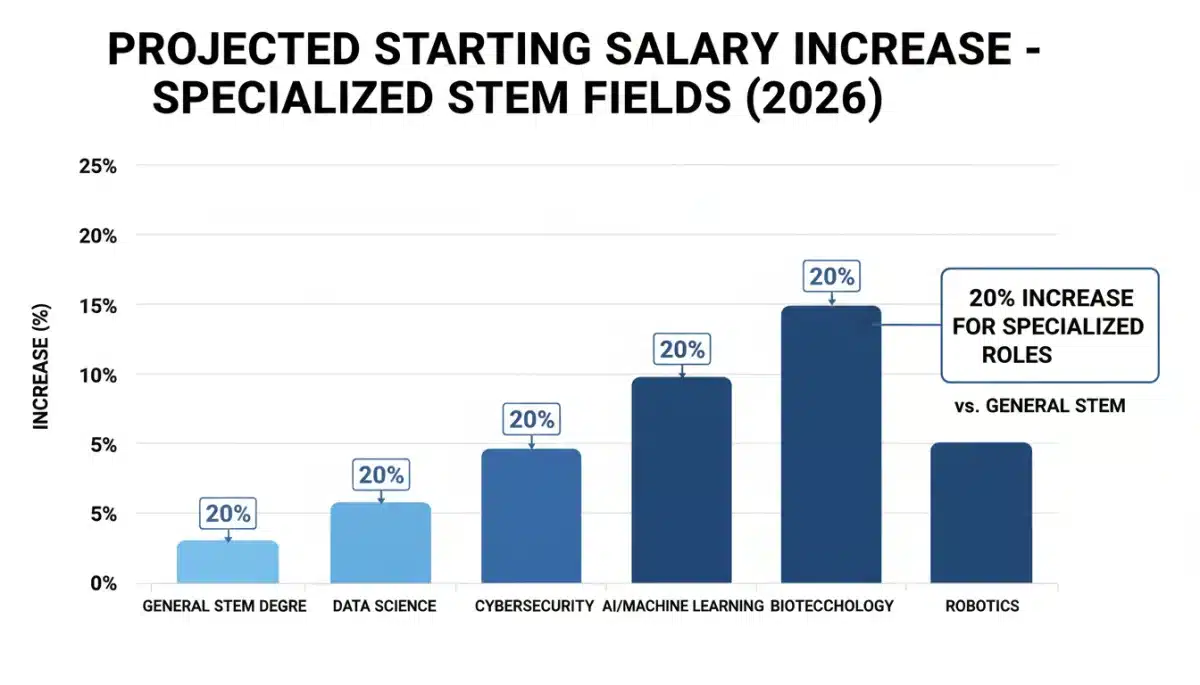
The 20% higher starting salary isn’t just a number; it represents a strategic investment by employers. They recognize that specialized skills lead to faster innovation, greater efficiency, and a stronger competitive edge. For individuals, this means not only a more lucrative career path but also greater job security and opportunities for continuous professional growth within their chosen niche. It’s a clear signal that the future of STEM careers lies in targeted, deep expertise.
Educational Pathways to Specialized STEM Careers
Achieving a specialized STEM career that commands a 20% higher starting salary by 2026 requires a deliberate and strategic approach to education. While a bachelor’s degree in a foundational STEM field is often the starting point, advanced degrees, certifications, and continuous learning are increasingly essential to developing the deep expertise employers seek. The pathway isn’t always linear, but it always involves a commitment to focused skill development.
Universities and technical institutions are adapting their curricula to meet these emerging demands, offering specialized master’s programs, graduate certificates, and interdisciplinary courses. Online learning platforms also play a crucial role, providing flexible options for upskilling and reskilling in niche areas.
Effective Educational Strategies
Prospective students should consider a multi-faceted approach to their education, combining formal academic programs with practical, hands-on experience.
- Advanced Degrees: Master’s or Ph.D. programs in specific STEM sub-disciplines (e.g., Master’s in Data Science, Ph.D. in Robotics).
- Professional Certifications: Industry-recognized certifications in areas like cybersecurity, cloud computing, or project management.
- Internships and Co-ops: Gaining practical experience in specialized roles during academic pursuits.
- Interdisciplinary Studies: Combining STEM with other fields like business, ethics, or design to create unique skill sets.
The journey to specialization often involves a blend of theoretical knowledge and practical application. Engaging in research projects, participating in hackathons, and contributing to open-source initiatives can further solidify specialized skills and make a candidate highly attractive to employers. The key is to build a portfolio of expertise that clearly demonstrates proficiency in a chosen niche, paving the way for those higher starting salaries.
The Role of Continuous Learning and Adaptability
In the rapidly evolving STEM landscape, simply acquiring a specialized degree is not enough to sustain a 20% higher starting salary long-term. The most successful professionals by 2026 will be those who embrace continuous learning and demonstrate exceptional adaptability. Technologies, methodologies, and industry needs are constantly shifting, requiring professionals to regularly update their skill sets and stay abreast of new developments. This commitment to lifelong learning is a hallmark of high-value STEM talent.
The shelf life of technical skills is shrinking, meaning that what is cutting-edge today might be commonplace tomorrow. Therefore, professionals must proactively seek out new knowledge, whether through formal education, online courses, industry workshops, or self-directed study. This proactive approach ensures that their specialized skills remain relevant and in high demand.
Strategies for Lifelong Learning in STEM
To maintain a competitive edge and justify higher compensation, STEM professionals should integrate various learning strategies into their career development.
- Regular Skill Audits: Periodically assess current skills against industry demands and identify gaps.
- Online Courses and MOOCs: Utilize platforms like Coursera, edX, or Udacity for specialized knowledge acquisition.
- Professional Associations: Engage with industry groups for networking, workshops, and access to cutting-edge research.
- Mentorship and Peer Learning: Learn from experienced professionals and collaborate with peers on challenging projects.
Adaptability is equally crucial. This involves not only learning new technologies but also being open to new ways of thinking, collaborating, and problem-solving. Professionals who can pivot quickly, integrate new tools, and apply their specialized knowledge to novel situations will continue to command premium salaries. The future belongs to those who view learning as an ongoing journey, not a destination.
Broader Economic and Societal Impact of STEM Specialization
The financial impact of specialized STEM education extends far beyond individual starting salaries. The concentration of highly skilled professionals in critical areas has profound broader economic and societal benefits, particularly for the United States. By fostering a workforce with deep expertise in fields like AI, biotechnology, and sustainable energy, the nation strengthens its innovation capacity, enhances global competitiveness, and addresses pressing challenges ranging from climate change to public health.
These specialized roles drive research and development, create new industries, and generate high-value jobs throughout the economy. The ripple effect of a robust, specialized STEM workforce can lead to increased productivity, economic growth, and an improved quality of life for all citizens. Furthermore, it positions the US as a leader in technological advancement and scientific discovery.
Key Societal Benefits
Investing in specialized STEM education is an investment in the nation’s future, yielding benefits across multiple sectors.
- Enhanced Innovation: Specialists drive breakthroughs in technology and science, leading to new products and services.
- Economic Growth: High-paying STEM jobs stimulate local economies and attract further investment.
- Global Competitiveness: A skilled workforce ensures the US remains a leader in critical technological sectors.
- Problem Solving: Specialized expertise is vital for tackling complex challenges like pandemics, climate change, and cybersecurity threats.
The focus on achieving a 20% higher starting salary for specialized STEM graduates is not just about individual financial gain; it’s a reflection of the strategic importance these roles hold for the nation’s prosperity and security. As we move towards 2026, the continued emphasis on cultivating deep, niche expertise within STEM fields will be a cornerstone of both individual success and collective societal advancement.
| Key Aspect | Brief Description |
|---|---|
| Salary Premium | Specialized STEM graduates are projected to earn 20% higher starting salaries by 2026. |
| Demand Drivers | Technological convergence, data explosion, and Industry 4.0 fuel specialization demand. |
| Key Specializations | AI, Cybersecurity, Bioinformatics, and Robotics are high-value fields. |
| Continuous Learning | Lifelong learning and adaptability are crucial for sustained career and financial growth. |
Frequently Asked Questions About STEM Specialization and Salaries
A specialized STEM education refers to an academic or professional pathway focusing deeply on a specific sub-discipline within STEM, such as AI engineering, bioinformatics, or quantum computing, beyond a general foundational degree. It involves advanced coursework, research, and practical application in a niche area, equipping graduates with highly sought-after expertise.
Specialized STEM graduates are projected to earn 20% more due to high demand for their unique skills, a limited supply of qualified talent, and the critical impact their expertise has on innovation and problem-solving for companies. Employers are willing to pay a premium for individuals who can immediately contribute to complex, cutting-edge projects.
By 2026, specializations such as Artificial Intelligence and Machine Learning, Cybersecurity Engineering, Bioinformatics, Quantum Computing, and Renewable Energy Engineering are anticipated to offer some of the highest salary potentials. These fields are at the forefront of technological advancement and industry demand, driving up compensation for experts.
While not always strictly necessary, a master’s degree or higher often provides the depth of knowledge and research experience required for true specialization in many STEM fields. However, professional certifications, intensive bootcamps, and relevant work experience can also lead to specialization, particularly in rapidly evolving tech sectors.
To stay competitive, continuous learning and adaptability are paramount. This includes regularly updating skills through online courses, professional certifications, attending industry conferences, and engaging in lifelong learning. Networking with peers, seeking mentorship, and actively participating in research or open-source projects also contribute significantly to long-term career success.
Conclusion
The future of STEM careers, particularly by 2026, is undeniably shaped by specialization. The compelling projection of a 20% higher starting salary for graduates with niche expertise serves as a clear indicator of market demand and the strategic value employers place on deep, focused knowledge. As technology continues its relentless march forward, and industries face increasingly complex challenges, the need for highly specialized professionals in fields like AI, cybersecurity, and bioinformatics will only intensify. Prospective students and current professionals who strategically invest in specialized education and commit to continuous learning will not only secure more lucrative career paths but also play a pivotal role in driving innovation and addressing critical societal needs. The financial impact is significant, but the broader contributions to economic growth and human advancement are equally profound.