
New 2026 education technology will profoundly transform classrooms within six months, ushering in an era of personalized, interactive, and highly effective learning experiences.
The educational landscape is on the brink of an unprecedented shift. In just half a year, new advances in 2026 education technology are poised to revolutionize how students learn and teachers instruct, promising a dynamic and engaging future for classrooms across the United States.
The dawn of personalized learning ecosystems
The concept of a one-size-fits-all education is rapidly becoming obsolete. In 2026, technology is enabling truly personalized learning ecosystems, adapting to each student’s unique pace, style, and needs. This isn’t merely about digital textbooks; it’s about intelligent systems that understand and respond to individual learning journeys.
These systems leverage sophisticated algorithms and artificial intelligence to create tailored curricula. They identify strengths and weaknesses, recommend specific resources, and even adjust the difficulty of tasks in real-time. The goal is to maximize engagement and ensure every student reaches their full potential.
Adaptive AI tutors and content curation
One of the most impactful developments is the rise of adaptive AI tutors. These virtual mentors provide instant feedback, explain complex concepts in multiple ways, and offer practice problems customized to individual student performance. They act as tireless, always-available learning companions.
- AI-driven assessments provide immediate, actionable insights.
- Personalized content streams cater to diverse learning preferences.
- Real-time progress tracking informs both students and educators.
- Virtual study groups facilitated by AI connect students with similar needs.
Beyond tutoring, AI also plays a crucial role in curating educational content. It sifts through vast amounts of information, selecting the most relevant, up-to-date, and engaging materials for specific topics, ensuring students always have access to high-quality resources. This dramatically reduces the time teachers spend searching for appropriate content.
In conclusion, personalized learning ecosystems, powered by advanced AI, are fundamentally changing the student experience. They promise a future where education is truly responsive, engaging, and effective for every learner, setting a new standard for classroom transformation.
Immersive learning experiences: beyond the screen
Forget passive screen time; 2026 education technology is ushering in an era of immersive learning. Virtual Reality (VR), Augmented Reality (AR), and Mixed Reality (MR) are no longer futuristic concepts but integral tools transforming how students interact with educational content. These technologies create environments where learning becomes an active, sensory experience.
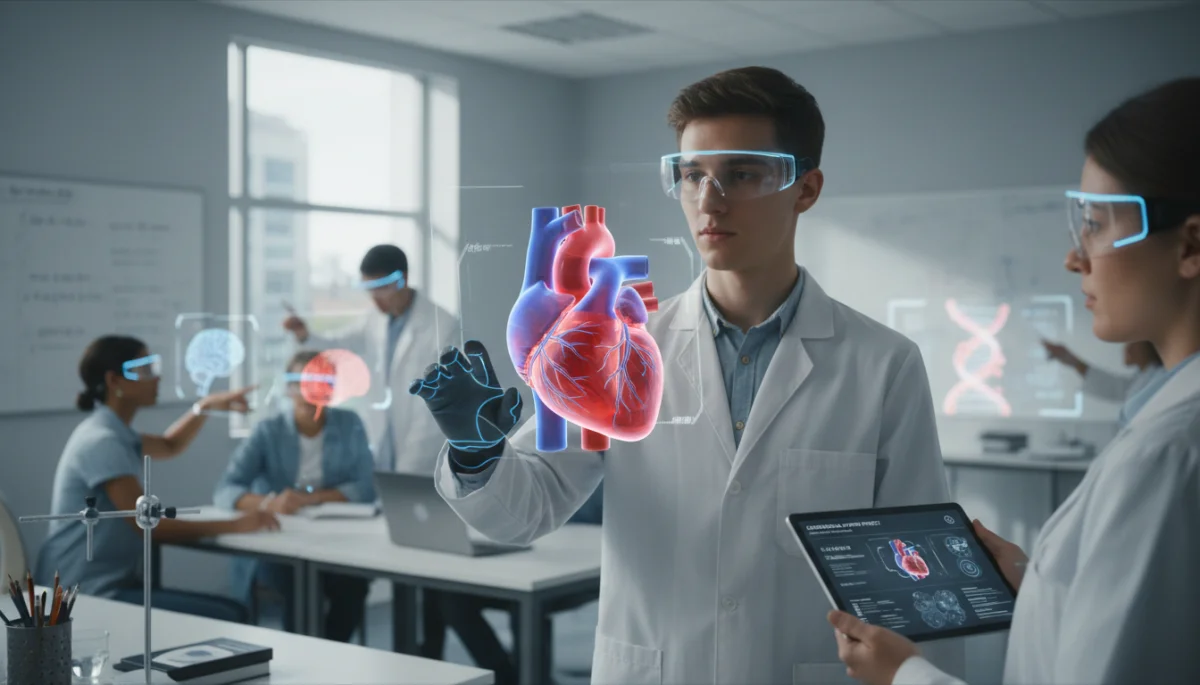
Students can now explore ancient civilizations, dissect virtual organs, or journey through the solar system, all from the comfort of their classroom. This level of immersion fosters deeper understanding and retention, making abstract concepts tangible and engaging.
Virtual field trips and simulations
VR technology enables virtual field trips that transport students to any location imaginable, from the Amazon rainforest to the surface of Mars. These experiences offer context and perspective that traditional textbooks simply cannot. Moreover, realistic simulations allow students to practice complex procedures or experiments in a safe, controlled digital environment.
- Experience historical events firsthand through VR.
- Conduct dangerous chemical experiments safely in a virtual lab.
- Explore inaccessible geographical locations globally.
- Practice surgical procedures or engineering tasks without risk.
Augmented Reality, on the other hand, overlays digital information onto the real world. Imagine pointing a tablet at a textbook image and seeing a 3D model pop out, or using AR glasses to view anatomical structures on a classroom skeleton. This blend of physical and digital enhances interaction and comprehension.
The impact of immersive technologies is profound, transforming learning from a two-dimensional experience into a multi-sensory adventure. This shift is not just about making learning fun, but about making it fundamentally more effective and memorable for students.
Collaborative digital spaces and global classrooms
The traditional classroom often limited collaboration to small groups within the same physical space. In 2026, education technology is tearing down these walls, creating dynamic digital spaces where students can collaborate seamlessly, regardless of their physical location. This fosters a global classroom environment, connecting learners from diverse backgrounds.
These platforms go beyond simple video conferencing; they offer shared virtual whiteboards, real-time document editing, and integrated project management tools. Students can co-create, problem-solve, and present together, developing crucial 21st-century skills like communication and teamwork.
Cloud-based platforms and secure sharing
Central to this transformation are robust cloud-based platforms that ensure secure access and sharing of educational resources. These platforms allow students and teachers to work on projects simultaneously, store materials, and communicate effectively from any device, anywhere.
- Real-time document collaboration enhances group projects.
- Integrated communication tools facilitate peer-to-peer learning.
- Secure cloud storage ensures accessibility and data protection.
- Global project partnerships connect students across continents.
The ability to connect with peers and experts worldwide enriches the learning experience significantly. Students gain exposure to different perspectives, cultures, and problem-solving approaches, preparing them for an increasingly interconnected world. This global collaboration cultivates empathy and a broader understanding of complex issues.
In essence, collaborative digital spaces are redefining the boundaries of the classroom. They empower students to work together more effectively, engage with a wider community, and develop skills essential for future success in a globalized society.
Data-driven instruction and teacher empowerment
While technology often focuses on the student experience, 2026 education technology is equally transformative for educators. Data-driven instruction is empowering teachers with unprecedented insights into student performance and learning patterns, allowing them to make more informed and effective pedagogical decisions.
Advanced analytics tools collect and interpret data from various learning activities, providing teachers with a comprehensive view of each student’s progress. This goes beyond simple test scores, offering insights into engagement levels, areas of struggle, and optimal learning strategies.
Predictive analytics and early intervention
One of the most powerful applications of this data is predictive analytics. AI systems can identify students at risk of falling behind even before they struggle significantly. This allows teachers to implement early interventions, providing targeted support precisely when and where it’s needed most.
- Identify learning gaps with precise data analysis.
- Tailor instructional methods based on student performance trends.
- Automate routine administrative tasks, freeing up teacher time.
- Provide timely feedback to students for improved outcomes.
Furthermore, technology is automating many administrative tasks, such as grading quizzes, tracking attendance, and managing assignments. This frees up valuable teacher time, allowing them to focus more on direct instruction, personalized mentorship, and professional development. Teachers become facilitators of learning, supported by intelligent systems.
Ultimately, data-driven instruction and teacher empowerment technologies are creating a more efficient and effective educational environment. Educators can now leverage powerful tools to understand their students better, intervene proactively, and dedicate more time to the art of teaching.
Accessibility and inclusivity: breaking down barriers
A cornerstone of new 2026 education technology is its commitment to accessibility and inclusivity. Technology is actively working to dismantle barriers to learning, ensuring that every student, regardless of their physical, cognitive, or socioeconomic circumstances, has equal access to high-quality education.
This includes advancements in assistive technologies, adaptive interfaces, and flexible learning modalities. The goal is to create an educational environment where diversity is not just accommodated but celebrated, and every student feels supported and empowered to learn.
Assistive technologies and universal design for learning
Innovations in assistive technologies are particularly impactful. Text-to-speech, speech-to-text, eye-tracking software, and haptic feedback devices are becoming standard, enabling students with diverse needs to interact with digital content effectively. These tools are integrated directly into learning platforms.
- Closed captions and transcripts for all video content.
- Customizable font sizes, colors, and contrast options.
- Alternative input methods for students with motor impairments.
- Multilingual support to assist English language learners.
Universal Design for Learning (UDL) principles are deeply embedded in the development of new educational software. This means that learning materials are designed from the outset to be flexible and adaptable, offering multiple means of representation, engagement, and expression. This proactive approach minimizes the need for retrofitting accessibility features.
The focus on accessibility and inclusivity ensures that the transformative power of 2026 education technology reaches all students. By designing for diversity, these innovations are fostering a more equitable and supportive learning environment for everyone.
Preparing for the future: skills for a changing world
The rapid integration of new education technology isn’t just about improving current learning; it’s about preparing students for a future that is constantly evolving. The skills required for success in 2026 and beyond are vastly different from those emphasized in traditional curricula. Technology is helping to cultivate these essential future-ready competencies.
Critical thinking, creativity, problem-solving, digital literacy, and adaptability are paramount. Educational technology provides the platforms and tools necessary for students to develop these skills through active engagement, project-based learning, and real-world simulations.
Computational thinking and digital citizenship
Computational thinking, a problem-solving process that involves breaking down complex problems into smaller, more manageable parts, is being integrated into curricula through coding platforms and logic games. This isn’t just for future programmers but for anyone needing to navigate a tech-driven world.
- Coding and robotics programs foster logical reasoning.
- Digital literacy modules teach responsible online behavior.
- Project-based learning encourages creative problem-solving.
- Data analysis tools develop critical thinking skills.
Digital citizenship is another vital skill being addressed. As students spend more time online, understanding digital ethics, cybersecurity, and responsible social media use becomes crucial. Educational technology platforms often incorporate lessons and guidelines to instill these values, ensuring students are not just tech-savvy but also responsible digital citizens.
By focusing on these forward-looking skills, 2026 education technology is not just transforming classrooms but also shaping the next generation of innovators, thinkers, and leaders, equipping them with the tools they need to thrive in an unpredictable future.
| Key Transformation | Brief Impact Description |
|---|---|
| Personalized Learning | AI tailors content and pace to individual student needs, maximizing engagement and outcomes. |
| Immersive Experiences | VR/AR creates interactive, sensory learning environments, making abstract concepts tangible. |
| Global Collaboration | Digital platforms enable seamless teamwork and connection with peers worldwide. |
| Data-Driven Instruction | Analytics empower teachers with insights for proactive, targeted student support. |
Frequently asked questions about 2026 education technology
The primary driver is the rapid advancement and integration of artificial intelligence and immersive technologies like VR/AR, which enable highly personalized and interactive learning experiences previously unavailable to most classrooms.
Teachers will transition from being primary knowledge dispensers to facilitators and mentors. Professional development will focus on leveraging AI tools, interpreting data analytics, and integrating immersive experiences into their curricula effectively.
A major focus of 2026 edtech is universal accessibility. Developers are incorporating assistive technologies and Universal Design for Learning principles to ensure equitable access for students with diverse needs, including those with disabilities or language barriers.
Students will develop essential 21st-century skills such as critical thinking, complex problem-solving, digital literacy, collaboration, and adaptability, all crucial for thriving in a rapidly evolving global workforce.
Challenges include funding for infrastructure and devices, ensuring equitable access in underserved areas, adequate teacher training, and ongoing technical support to manage and maintain advanced technological ecosystems within schools.
Conclusion
The trajectory of education is clear: within the next six months, 2026 education technology will fundamentally reshape classrooms. From personalized learning driven by AI to immersive VR experiences and globally connected collaborative spaces, the future of learning is dynamic, engaging, and deeply responsive to individual student needs. This rapid transformation promises not only to enhance academic outcomes but also to equip students with the critical skills necessary to navigate and thrive in an increasingly complex and technologically advanced world. Educators, students, and institutions alike stand at the precipice of an exciting new era, where technology serves as a powerful catalyst for unprecedented educational excellence.