
NASA’s 2026 budget prioritizes lunar exploration via Artemis, Mars sample return, and advancing climate science, alongside robust support for foundational research and international collaboration to further human and robotic presence in space.
The landscape of space exploration is constantly evolving, with each passing year bringing new ambitions and challenges. As we look towards 2026, understanding The Future of Space Exploration: NASA’s 2026 Budget Allocations and Mission Priorities – RECENT UPDATES becomes crucial for anyone interested in humanity’s journey beyond Earth. This article delves into the intricate details of NASA’s financial blueprint and strategic objectives, offering a comprehensive overview of where our space agency is headed.
Setting the Stage: NASA’s Strategic Vision for 2026
NASA’s strategic vision for 2026 is meticulously crafted to advance scientific understanding, inspire future generations, and extend human presence deeper into the solar system. This vision is not merely about launching rockets; it encompasses groundbreaking research, technological innovation, and fostering international partnerships. The agency’s commitment to exploration is balanced with a strong emphasis on Earth science, recognizing the critical role space-based observations play in understanding our changing planet.
Key to this vision is the continued development of capabilities that enable sustained human operations on the Moon and, eventually, Mars. The Artemis program stands at the forefront of these efforts, aiming to establish a long-term human presence on the lunar surface. Beyond human exploration, robotic missions continue to push the boundaries of scientific discovery, investigating distant planets, asteroids, and the very origins of the universe.
The Artemis Program: Gateway to Deep Space
The Artemis program remains NASA’s flagship initiative for human spaceflight, serving as a cornerstone of the 2026 budget. Its primary goal is to return humans to the Moon, including the first woman and first person of color, and to establish a sustainable presence there. This lunar base will act as a proving ground for technologies and procedures necessary for future missions to Mars.
- Lunar Landers Development: Significant funding is allocated for the Human Landing System (HLS) to ensure the timely development and testing of lunar landers capable of transporting astronauts to and from the lunar surface.
- Gateway Lunar Outpost: Investment continues in the Lunar Gateway, a small space station orbiting the Moon, which will provide vital support for long-duration missions and serve as a staging point for exploration.
- Orion Spacecraft Production: Ongoing production and upgrades for the Orion spacecraft are critical for crew transport, ensuring the safety and capability of astronauts on their journey to and from lunar orbit.
The strategic importance of Artemis extends beyond simply returning to the Moon; it’s about building an infrastructure for sustained exploration and scientific research. The lessons learned and technologies developed through Artemis will be directly applicable to the ambitious goal of sending humans to Mars.
In essence, NASA’s 2026 strategic vision is a tapestry woven with threads of bold exploration, rigorous scientific inquiry, and a commitment to understanding both our cosmic neighborhood and our home planet. The budget allocations reflect these priorities, aiming to maximize returns on investment for the American taxpayer and the global scientific community.
Budget Allocations for Lunar Exploration and Mars Missions
The 2026 budget for NASA reflects a strong commitment to both lunar exploration through the Artemis program and the ambitious goal of human and robotic missions to Mars. These two pillars of deep space exploration receive substantial financial backing, highlighting their strategic importance in advancing humanity’s reach.
Funding for lunar activities is designed to accelerate the development of critical systems and infrastructure. This includes not only the hardware for getting to and from the Moon but also the technologies needed for living and working on its surface for extended periods. The budget also ensures continued progress on the Mars Sample Return mission, a high-priority scientific endeavor.
Artemis Program Funding Breakdown
The Artemis program continues to be a central focus, with significant portions of the budget dedicated to its various components. This comprehensive approach ensures that all necessary elements are in place for successful lunar missions.
- Space Launch System (SLS): Continued funding for the powerful SLS rocket, essential for launching Orion spacecraft and heavy cargo to the Moon, remains a top priority to maintain launch cadence.
- Human Landing System (HLS): A substantial allocation supports the development and procurement of lunar landers from commercial partners, fostering innovation and competition in the space industry.
- Lunar Surface Infrastructure: Investments are earmarked for technologies like lunar rovers, habitats, and power systems necessary for sustained human presence and scientific operations on the Moon.
These allocations underscore NASA’s determination to not only return to the Moon but to establish a durable presence that can serve as a stepping stone for further exploration.
Advancing Towards Mars: Robotic and Human Pathways
While Artemis lays the groundwork on the Moon, NASA’s sights remain firmly set on Mars. The 2026 budget allocates funds to critical robotic missions and research that will pave the way for eventual human expeditions to the Red Planet.
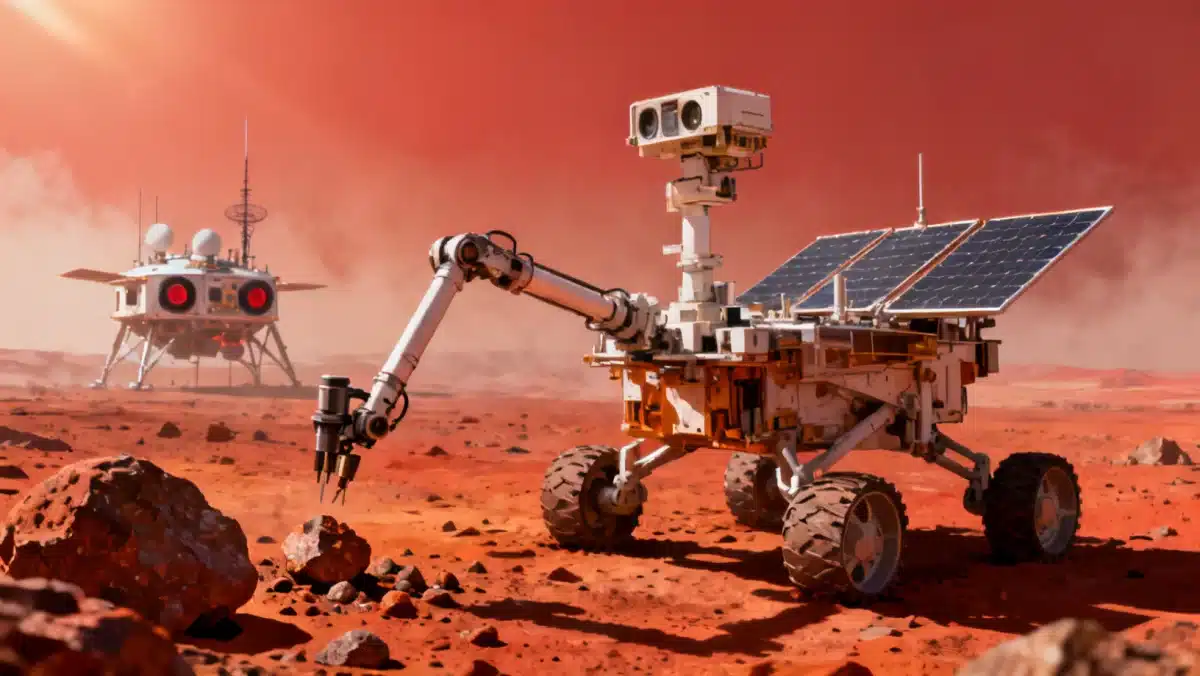
The Mars Sample Return (MSR) campaign stands out as a key scientific priority. This complex international effort aims to bring Martian rock and soil samples back to Earth for detailed analysis, potentially revealing evidence of past life on Mars.
Furthermore, research into propulsion technologies, radiation shielding, and closed-loop life support systems receives continued investment. These advancements are crucial for mitigating the risks and challenges of long-duration human missions to Mars. The agency recognizes that a successful human mission to Mars requires a methodical, step-by-step approach, building on the successes of lunar exploration and robotic precursors.
In summary, the 2026 budget demonstrates a clear strategic intent to push the boundaries of human and robotic exploration, with both the Moon and Mars serving as interconnected destinations in NASA’s ambitious future plans.
Science Missions and Earth Observation: A Dual Focus
NASA’s 2026 budget reinforces its dual commitment to understanding the cosmos and safeguarding our home planet. While deep space exploration captures headlines, a significant portion of the agency’s funding is dedicated to groundbreaking science missions across various disciplines and comprehensive Earth observation programs. This balanced approach ensures that NASA continues to be a global leader in scientific discovery and climate research.
The scientific portfolio spans astrophysics, planetary science, heliophysics, and Earth science, each with critical missions planned or underway. These missions provide invaluable data, expanding our knowledge of the universe and informing crucial decisions about our environment.
Astrophysics and Planetary Science Endeavors
Astrophysics missions aim to unravel the mysteries of the universe, from the formation of stars and galaxies to the search for exoplanets. Planetary science investigates other celestial bodies within our solar system, seeking to understand their origins, evolution, and potential for life.
- James Webb Space Telescope Operations: Continued funding for the operational phase of the James Webb Space Telescope (JWST) ensures its groundbreaking observations continue, providing unprecedented insights into the early universe and exoplanet atmospheres.
- Europa Clipper: The Europa Clipper mission, set for launch, receives sustained support to explore Jupiter’s moon Europa, a prime candidate for hosting extraterrestrial life due to its subsurface ocean.
- VERITAS Mission: Funding is allocated for the development of the VERITAS mission to Venus, which will map the planet’s surface and investigate its geological history, offering clues about why Earth and Venus evolved so differently.
These missions represent the cutting edge of scientific inquiry, promising to deliver revolutionary discoveries that redefine our understanding of the cosmos.
Earth Science and Climate Research Initiatives
NASA’s role in Earth science is more critical than ever, with a focus on monitoring climate change and its impacts. The 2026 budget prioritizes missions and research that provide foundational data for climate models and environmental policy.
Initiatives include a robust Earth System Observatory (ESO), a new generation of Earth-observing satellites designed to provide a holistic view of our planet. These missions will track key climate indicators such as sea level rise, ice sheet changes, carbon emissions, and atmospheric composition with unprecedented accuracy.
Furthermore, investments in climate modeling and data analysis tools are crucial for translating satellite observations into actionable insights. This data is vital for governments, scientists, and communities worldwide in adapting to and mitigating the effects of a changing climate. The dual focus on cosmic discovery and terrestrial stewardship exemplifies NASA’s expansive and impactful mission.
Technological Advancements and Commercial Partnerships
NASA’s 2026 budget places a significant emphasis on fostering technological advancements and leveraging commercial partnerships to achieve its ambitious goals. Recognizing that innovation often thrives outside traditional government structures, the agency actively seeks to collaborate with private industry, driving down costs and accelerating development timelines. This approach is not just about efficiency; it’s about expanding the ecosystem of space exploration, making it more robust and sustainable.
The agency’s investment in cutting-edge technologies spans various domains, from advanced propulsion systems to autonomous robotics and in-situ resource utilization. These foundational technologies are crucial for enabling future missions that are currently beyond our capabilities.
Driving Innovation Through Research and Development
Research and development (R&D) are the lifeblood of NASA, and the 2026 budget allocates substantial funds to push the boundaries of what is possible. These investments are critical for developing the next generation of space exploration tools and techniques.
- Advanced Propulsion Systems: Funding is directed towards developing more efficient and faster propulsion technologies, such as nuclear thermal propulsion, which could drastically reduce travel times to Mars.
- Robotics and Autonomy: Investments support the creation of more intelligent and adaptable robotic systems capable of performing complex tasks in hazardous environments, reducing the need for direct human intervention.
- In-Situ Resource Utilization (ISRU): Research into ISRU technologies aims to enable astronauts to live off the land on the Moon and Mars, converting local resources into water, oxygen, and fuel, thereby reducing mission costs and increasing sustainability.
These R&D efforts are not just theoretical; they are directly tied to the success of future missions, providing the necessary technological backbone for endeavors like sustained lunar presence and human missions to Mars.
Strengthening Commercial Space Partnerships
NASA’s strategy includes a strong reliance on commercial partners, fostering a vibrant private space industry. This collaboration extends across various aspects of space exploration, from cargo delivery to human spaceflight.
The Commercial Lunar Payload Services (CLPS) initiative continues to receive significant funding, enabling private companies to deliver scientific instruments and technology demonstrations to the lunar surface. This approach allows NASA to conduct more frequent and diverse lunar science missions at a lower cost.
Furthermore, commercial crew and cargo services to the International Space Station (ISS) remain a cornerstone of NASA’s operational strategy, freeing up agency resources for deep space exploration. The 2026 budget also anticipates increased engagement with commercial entities for the development of private space stations, ensuring a continued human presence in low-Earth orbit beyond the ISS. These partnerships are instrumental in diversifying capabilities and ensuring the long-term viability of space exploration.
International Collaboration and Global Impact
International collaboration forms a vital component of NASA’s strategy, as reflected in its 2026 budget allocations and mission priorities. The agency recognizes that the challenges and opportunities of space exploration are often too vast for any single nation to tackle alone. By forging strong partnerships with space agencies and organizations worldwide, NASA amplifies its capabilities, shares expertise, and fosters a global community dedicated to scientific discovery and peaceful exploration.
These collaborations extend beyond mere resource sharing; they represent a commitment to shared scientific goals, ethical guidelines for space activities, and the collective advancement of humanity. The global impact of NASA’s international endeavors is profound, inspiring cooperation and fostering goodwill on an unprecedented scale.
Key International Partnerships and Joint Missions
NASA’s portfolio includes numerous joint missions and collaborations that are essential for achieving its long-term objectives. These partnerships are critical for sharing both the burdens and the triumphs of space exploration.
- International Space Station (ISS) Operations: Continued funding for the ISS partnership with Russia, Europe, Japan, and Canada ensures the ongoing operation of this unique orbiting laboratory, which serves as a testbed for human deep space exploration technologies and a platform for invaluable scientific research.
- Artemis Accords: Investment in diplomatic efforts related to the Artemis Accords, a set of principles for cooperation in lunar exploration, aims to establish a common framework for peaceful and responsible activities on the Moon and beyond.
- Mars Sample Return (MSR): The MSR campaign is a prime example of international cooperation, involving collaboration with the European Space Agency (ESA) to bring scientifically critical Martian samples back to Earth.
These partnerships not only facilitate complex missions but also build bridges between nations, promoting peace and understanding through shared scientific pursuits.
Global Impact and Future Collaborations
The global impact of NASA’s international collaborations extends far beyond the scientific community. By engaging with diverse nations, NASA contributes to the development of global space capabilities, inspires future generations across continents, and reinforces the idea that space exploration is a collective human endeavor.
Looking ahead, the 2026 budget supports initiatives to explore new partnership opportunities, particularly with emerging spacefaring nations. This includes sharing data, expertise, and even mission opportunities, thereby expanding the global footprint of space exploration. The development of a lunar economy, for instance, will likely involve a consortium of international players, leveraging diverse capabilities and investments.
In conclusion, international collaboration is not an ancillary activity for NASA; it is a fundamental pillar of its strategy. The 2026 budget reflects a clear understanding that complex, long-duration missions and global scientific challenges are best addressed through a united effort, maximizing both scientific returns and diplomatic dividends.
Addressing Challenges: Budgetary Constraints and Technical Hurdles
Despite ambitious plans, NASA’s 2026 budget allocations and mission priorities are inevitably shaped by a complex interplay of budgetary constraints and persistent technical hurdles. Navigating these challenges requires astute financial management, innovative engineering solutions, and a realistic assessment of capabilities. The agency must constantly balance its grand vision with the practicalities of finite resources and the inherent difficulties of pushing the boundaries of technology.
Successfully overcoming these obstacles is paramount to achieving NASA’s objectives, from returning humans to the Moon to unraveling the secrets of the universe. The agency’s ability to adapt and innovate in the face of adversity will largely determine the pace and scope of future space exploration.
Navigating Budgetary Limitations
Like all government agencies, NASA operates within specific budgetary frameworks, which often necessitate difficult choices between competing priorities. The 2026 budget reflects a careful allocation of funds to maximize impact while adhering to fiscal realities.
- Prioritization of Core Missions: Funds are strategically directed towards high-priority missions like Artemis and Mars Sample Return, sometimes requiring the deferral or scaling back of other projects.
- Cost-Saving Innovations: NASA actively seeks out and invests in technologies and processes that can reduce mission costs, such as commercial partnerships for launch services and in-situ resource utilization.
- Advocacy and Public Support: A portion of the agency’s efforts involves communicating the value and returns on investment of space exploration to secure continued public and congressional support, which is vital for sustained funding.
These measures are crucial for ensuring that NASA can continue to deliver on its mandate despite financial pressures. The agency’s transparency in its financial planning helps build trust and accountability.
Overcoming Technical Complexities
Space exploration is inherently fraught with technical challenges, from developing cutting-edge hardware to operating in extreme environments. The 2026 budget addresses these hurdles by investing heavily in research, testing, and risk mitigation.
One significant technical hurdle involves the development of life support systems for long-duration deep space missions. These systems must be highly reliable, self-sustaining, and capable of recycling resources efficiently to support astronauts for months or even years away from Earth. Another major challenge is radiation shielding, as astronauts venturing beyond Earth’s protective magnetosphere will be exposed to higher levels of cosmic radiation, necessitating advanced protective measures.
Furthermore, the precision required for autonomous landing systems on extraterrestrial bodies, particularly for human missions, demands extensive testing and refinement. The agency’s commitment to rigorous testing and iterative development cycles is a testament to its dedication to astronaut safety and mission success. Addressing these technical complexities is not just about engineering; it’s about pushing the very limits of human ingenuity and scientific understanding.
The Long-Term Vision: Beyond 2026 and Towards a Sustainable Future
While the 2026 budget outlines immediate priorities, it is intrinsically linked to NASA’s overarching long-term vision: to establish a sustainable presence in space and foster a future where humanity is a multi-planetary species. This vision extends far beyond the next fiscal year, encompassing decades of planned exploration, scientific discovery, and technological maturation. The decisions made today regarding budget allocations and mission priorities are foundational to realizing these ambitious, distant goals.
Achieving this sustainable future requires not only technological breakthroughs but also a robust economic model for space, a commitment to environmental stewardship in space, and the continuous inspiration of new generations to pursue careers in STEM fields.
Establishing a Sustainable Lunar Presence
The Artemis program, funded significantly in the 2026 budget, is the cornerstone of establishing a sustainable lunar presence. This involves more than just periodic visits; it means developing the infrastructure and capabilities for humans to live and work on the Moon for extended periods.
- Lunar Base Development: Future budgets will likely see increased investment in permanent lunar habitats, power generation systems, and communication networks, enabling continuous human operations.
- Resource Extraction: Research and development into extracting resources like water ice from the lunar poles will be crucial for self-sufficiency, providing propellant and life support consumables.
- Scientific Outposts: Establishing scientific outposts in strategically important regions, such as the lunar poles, will allow for unprecedented research into the Moon’s geology, history, and resources.
A sustainable lunar presence will not only advance scientific understanding but also serve as a critical testbed for technologies and operational procedures required for missions to Mars and beyond.
Paving the Way for Human Missions to Mars
The ultimate goal in NASA’s long-term human exploration strategy is to send astronauts to Mars. The efforts and investments outlined in the 2026 budget for Artemis and related technologies are directly contributing to this monumental endeavor.
Developing advanced heavy-lift launch capabilities, deep space habitats, and highly efficient propulsion systems are all steps on the path to Mars. The experience gained from living and working on the Moon will be invaluable in preparing astronauts for the even greater challenges of a Martian mission, including longer transit times, more extreme environmental conditions, and greater isolation.
Furthermore, international partnerships and commercial collaborations will be essential for sharing the immense costs and risks associated with such a complex undertaking. NASA’s long-term vision for Mars is not just about planting a flag; it’s about establishing a foundation for humanity’s permanent expansion into the solar system, ensuring our species’ long-term survival and future prosperity. The 2026 budget is a critical step in this multi-generational journey.
| Key Priority | Brief Description |
|---|---|
| Artemis Lunar Program | Sustained human presence on the Moon, including landers and Gateway development. |
| Mars Sample Return | Bringing Martian rock and soil samples to Earth for scientific analysis. |
| Earth Science Initiatives | Monitoring climate change and environmental factors with advanced satellites. |
| Commercial Partnerships | Leveraging private industry for cost-effective services and technology development. |
Frequently Asked Questions About NASA’s 2026 Plans
The primary goals include advancing the Artemis program for lunar exploration, continuing the Mars Sample Return campaign, expanding Earth science and climate research, and fostering technological innovation through commercial partnerships. These objectives aim to extend human presence in space and deepen our understanding of the universe and our home planet.
Artemis is a cornerstone of the 2026 priorities, receiving substantial funding for lunar lander development, the Gateway lunar outpost, and the Orion spacecraft. It aims to return humans to the Moon sustainably, serving as a critical stepping stone for future human missions to Mars and establishing a long-term lunar presence.
Commercial partnerships are crucial for NASA’s 2026 strategy, enabling cost-effective services like lunar payload delivery (CLPS) and ISS cargo/crew transport. These collaborations drive innovation, reduce agency costs, and expand the private space industry, allowing NASA to focus resources on deep space exploration.
Absolutely. NASA maintains a strong focus on Earth science in 2026, with significant investment in climate research and Earth observation missions. Initiatives like the Earth System Observatory provide vital data for understanding climate change, sea level rise, and other environmental factors, proving critical for informed decision-making.
International collaboration is fundamental, enabling complex missions like the Mars Sample Return with ESA and the continued operation of the ISS. These partnerships share expertise, resources, and costs, fostering global scientific advancement, diplomatic relations, and inspiring a collective human endeavor in space exploration.
Conclusion
NASA’s 2026 budget allocations and mission priorities paint a clear picture of an agency committed to pushing the boundaries of human and scientific endeavor. With a robust focus on the Artemis program, the ambitious Mars Sample Return campaign, and continued leadership in Earth science, the agency is strategically investing in a future where humanity’s reach extends further into the cosmos while simultaneously safeguarding our home planet. The emphasis on technological advancements and commercial partnerships underscores a pragmatic approach to innovation and efficiency, ensuring that taxpayer dollars yield maximum returns. As we look beyond 2026, these foundational investments are poised to pave the way for a sustainable human presence in space, inspiring generations and cementing NASA’s role as a beacon of exploration and discovery.